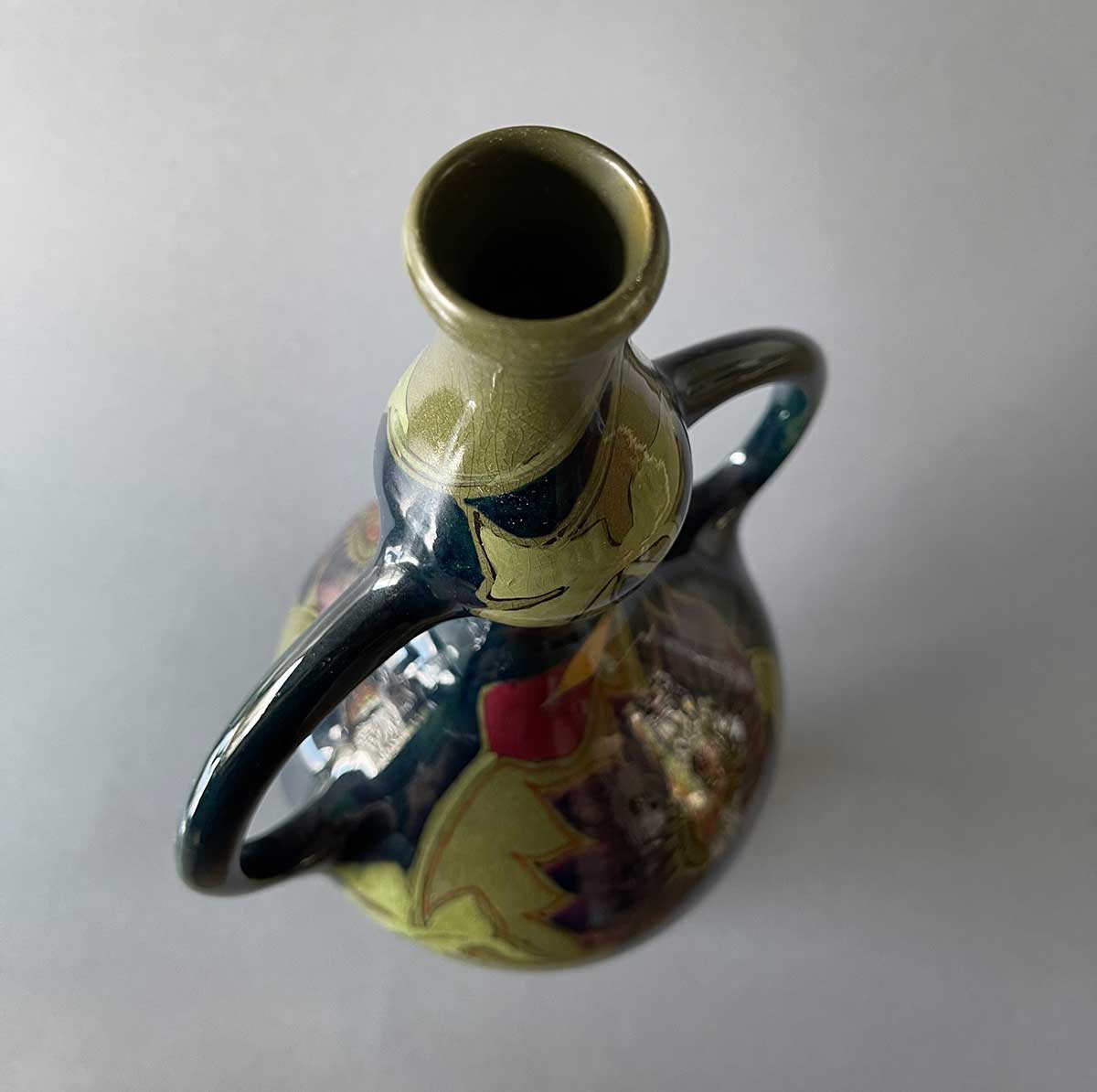


Egbert Estié (1865-1910) had an enormous influence on the Dutch pottery industry around the turn of the 20th century. He founded three well-known pottery factories and the peak of his career coincided with the heyday of Art Nouveau in the Netherlands. Estié was a creative and clever businessman who drew inspiration, among other things, from the success of his competitors.
The Dutch pottery industry was well established and has seen several highlights over the course of centuries. One of these highlights is the polychrome decorative pottery in the Art Nouveau style, which gained enormous popularity not only in the Netherlands but internationally around the end of the 19th century. This pottery is called ‘plateel’ in Dutch, after an old French term for a flat dish. Well-known pottery factories include Rozenburg in The Hague (1883-1917), Faience- and Tilefactory Holland in Utrecht (1895-1907), De Firma Wed. N.S.A. Brantjes in Purmerend (1895-1907), Haga in Purmerend (1904-1907), Plateelbakkerij Zuid-Holland in Gouda (1897-1963), and Porceleinfabriek De Kroon in Noordwijk (1906-1910).

From studio to pottery factory
Egbert Estié was involved as founder and owner of three of the pottery factories mentioned above. Estié began his career as a painter in Amsterdam. He had a “studio for the manufacture and sale of paintings, photographs, frames, and related articles.” In 1894 he met Clementine van Rijn, the widow of Nicolaas Brantjes. Brantjes owned a pottery factory in Purmerend for refractory oven tiles and crucibles. Estié convinced the widow to modify the kilns and start producing decorative pottery. On October 11, 1895 the firm Wed N.S.A. Brantjes & Co. applied for a permit to convert the factory to “construct it into a factory for the production of Delftware and other pottery,” according to the Purmerend municipal archives.

New opportunities in Gouda
Two years later, in 1897, Estié took on a new challenge: he started a company called Plateelbakkerij ‘Zuid-Holland’ E. Estie & Co. in Gouda, together with Adrianus Jonker. Gouda had been known for its pottery production (including Gouda tobacco pipes) since the 17th century, and Jonker was the heir to several pottery factories that produced coarse, brown kitchenware pottery. The Jonker family owned a significant amount of industrial real estate in Gouda’s city center, and one of the factories was converted to produce decorative pottery. Estié’s contribution to the factory’s founding included the expertise he had acquired in Purmerend, model drawings, and molds. His ambition, as evidenced by his entry in the trade register, was to: “Establish an industry in the spirit of the renowned Rozenburg and Delft pottery”.
Success through inspiration and imitation
Unfortunately, the archives of Plateelbakkerij Zuid-Holland were lost when the factory ultimately went bankrupt in the 1960s. However, recent research has reconstructed the first ten years of Plateelbakkerij Zuid-Holland (PZH). It reveals that Egbert Estié built a highly successful company in a short time, one that also achieved considerable international recognition. One of the reasons for this success is undoubtedly attributable to Estié’s artistic vision. But another part is also due to the fact that he drew inspiration from his competitors.

New book sheds light on the early years of PZH
The research into the first ten years of PZH was published in the spring of 2025 in the book “De Plateelbakkerij ‘Zuid-Holland’, 1897-1908, Another Look“. This book is about the early years of the factory and about the way models and decors have undergone a tremendous change in the search for success. The book describes the similarities between PZH models and those of other factories. Especially in PZH’s early production years, models and decors were inspired by the work of competitors. There are several early Gouda models that appear to be exact copies of models from the Faience and Tile Factory Holland in Utrecht. Not only the models, but also the painting style of this factory is reflected in many early objects. The influence of Holland-Utrecht seems much greater than that of other (then) popular factories, such as Brantjes in Purmerend (where Estié had previously worked) or Rozenburg in The Hague. We will never know whether it was his aim to imitate the style and quality of Holland-Utrecht or whether this was a result of the available workforce when Estié started his own factory in 1897, bringing several employees—model makers and pottery painters—with him from Purmerend and recruiting them from Utrecht, The Hague, and Delft.
Delftware from Gouda
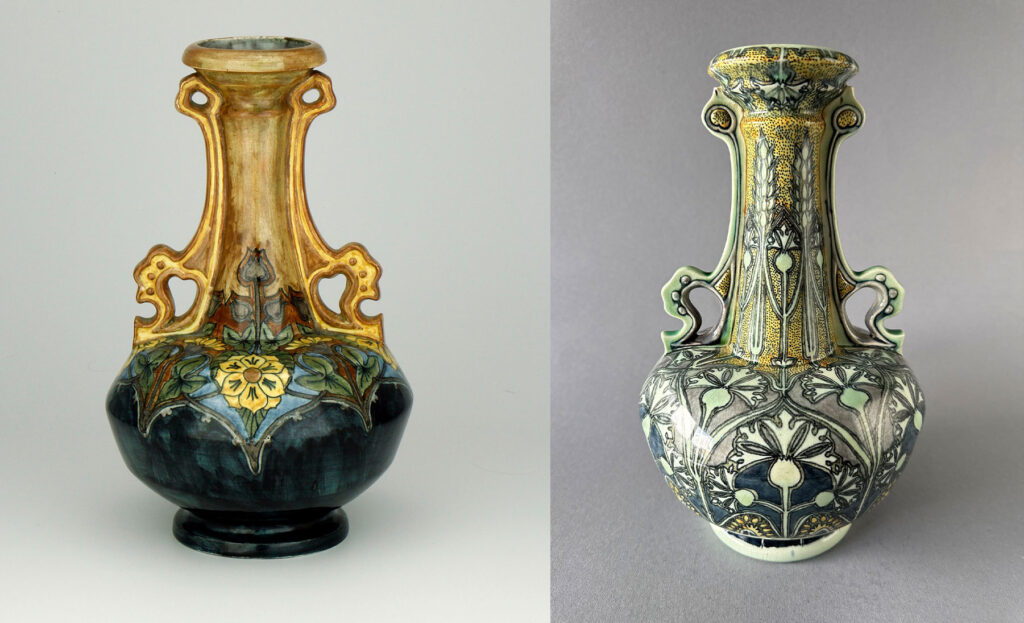
Estié introduced various decors in the first few years of production. The typical Gouda decor, in dark colours with floral motifs in typical Art Nouveau style, is of course very well-known. Another decor was the Delft decor, inspired by the success of Joost Thooft and Abel Labouchere of De Porceleyne Fles in Delft. In August 1900, Estié hired the renowned pottery painter Henri Breetvelt, who had worked at De Porceleyne Fles and who, together with his wife Cornelia de Mée, worked as independent ceramic artists. Breetvelt developed various Delft decors for PZH in the familiar blue and white, but also in polychrome, and decors consisted of flowers, birds, or typical Dutch style elements, such as landscapes with ships and windmills.

Porcelain decor based on eggshell porcelain from The Hague
Another ‘innovation’ by Egbert Estié was the P-decor. These objects are also called “kantjes” (lace ware), after the fine lines and dots that make up the decoration. These new decorations were inspired by the success of eggshell porcelain from the Rozenburg pottery factory in Den Haag (The Hague). In 1899 Rozenburg was working on a new type of ceramic, fired at higher temperatures. The result would be presented to the international public for the first time at the Exposition Universelle (World Fair) in Paris in April 1900. Rozenburg porcelain was creamy white, wafer-thin, almost transparent, and painted with Art Nouveau-style decorations inspired by Japanese prints and French naturalistic stylebooks.
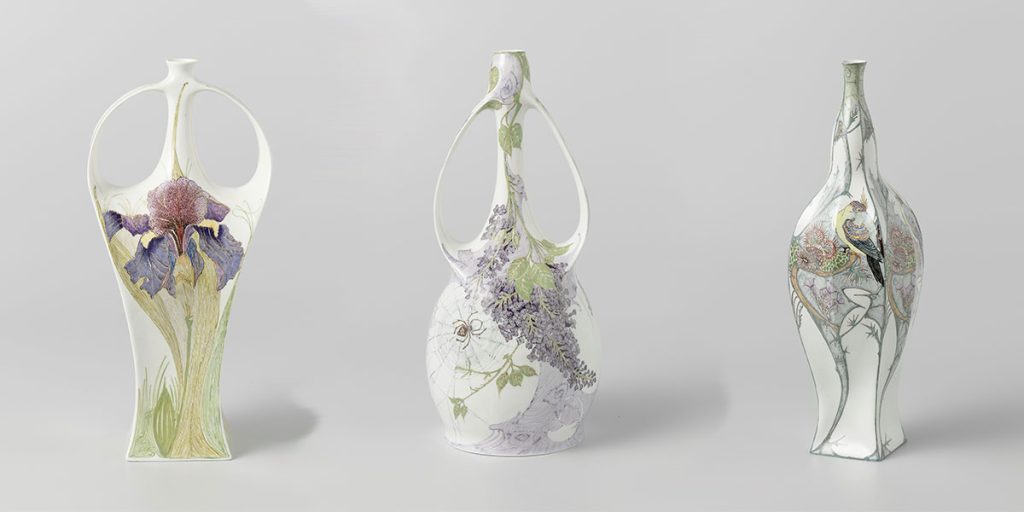
At the World Fair in Paris, the eggshell porcelain was a huge success. There was much praise for its technical achievements, production techniques, and decorations, which seamlessly aligned with the prevailing trends of the time. Rozenburg eggshell porcelain was painted with flowers, birds, and insects in color fields composed of delicate lines and dots, a necessity in the production process because the wafer-thin biscuit could not withstand solid layers of paint.
Estié under fire for his copies
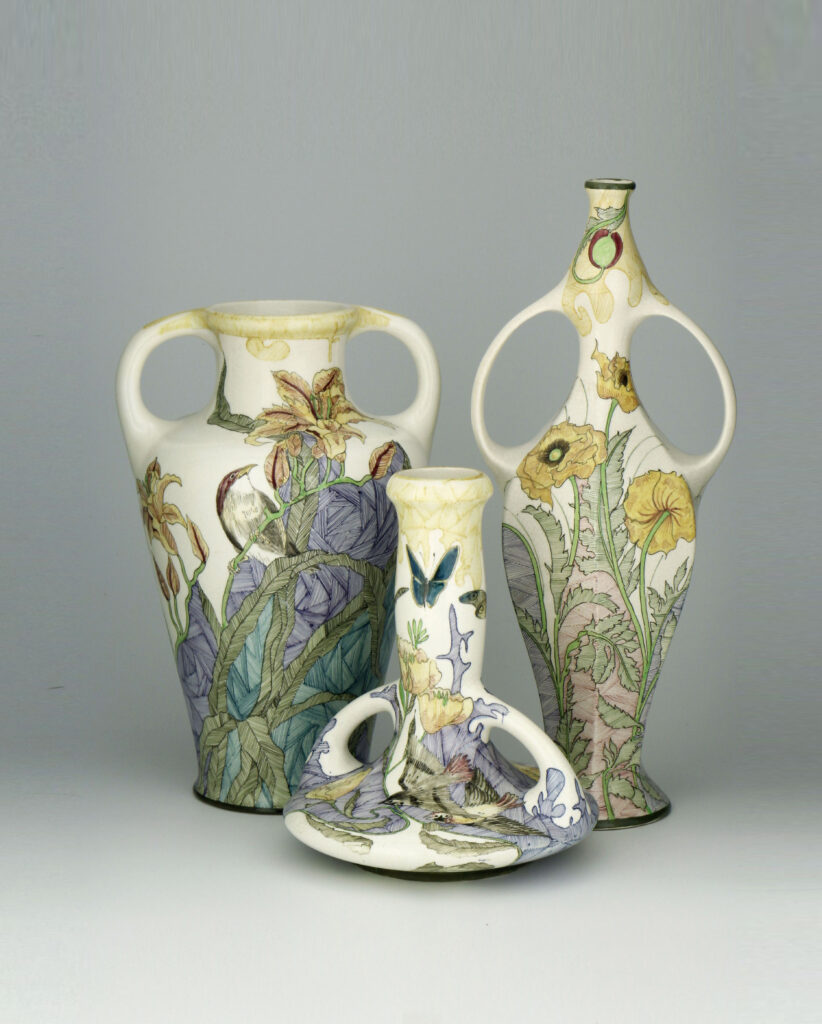
Egbert Estié launched his P-decor in 1901. The ‘P’ stands for ‘Porcelain’, leaving no doubt about the source of his inspiration. Objects with the P-decor were not made of porcelain, but of earthenware. Estié used his own models to produce the first P-production. From February 1901 several former Rozenburg pottery painters started their new jobs in Gouda, quickly expanding production of the popular P-decor. PZH also worked on introducing new models which bear a striking resemblance to well-known Rozenburg objects.
In 1902 the management of the Rozenburg factory complained about the increased competition from Gouda and the fact that many models and decors bore a strong resemblance to Rozenburg’s work. Because there was no legal basis for protecting intellectual property (the Dutch Patent Act only came into effect in 1910), there was little Rozenburg could do to stop Estié’s urge to copy. Rozenburg did threaten to ban PZH from participating in exhibitions and activities of the United Dutch Ceramic Manufacturers. PZH was also excluded from the 1902 World Fair in Turin because the factory did not “qualify to be represented.” The organizer’s main reason for this decision was that only “original work” would be permitted.
De Kroon as the end of a career
Estié left Plateelbakkerij Zuid-Holland in 1905 after a business conflict and sold his shares to the Hoyng family, directors of a chain of luxury household goods stores in The Hague, Utrecht and Amsterdam. A year later, in February 1906, Estié started a new factory: Porcelain Factory De Kroon (the crown) in Noordwijk. Estié’s ambition at De Kroon was to produce high-quality porcelain, as we can assume from the factory’s name. But despite this ambition Porcelain Factory De Kroon only produced earthenware in the three short years of its existence. Objects by De Kroon, often designed by Henri Breetvelt, are therefore very rare. At the end of 1906, Estié sold all his shares to his co-founder and financier, Carl Fortmann. Production ceased in 1909 and the factory went bankrupt in 1910. Egbert Estié died that same year at the age of 44.

Around 1900
This article was written by Carolien Vader for the September issue of the magazine: Around 1900, published by the Friends of New Art 1900 Association. You can read the entire magazine on the association’s website.
Many thanks to Ridgetop Collection for some of the photography, taken from the book: The Plateelbakkerij Zuid-Holland, 1897-1908, Another Look.